All content on this site is intended for healthcare professionals only. By acknowledging this message and accessing the information on this website you are confirming that you are a healthcare professional. If you are a patient or carer, please visit Know GvHD.
The GvHD Hub website uses a third-party service provided by Google that dynamically translates web content. Translations are machine generated, so may not be an exact or complete translation, and the GvHD Hub cannot guarantee the accuracy of translated content. The GvHD Hub and its employees will not be liable for any direct, indirect, or consequential damages (even if foreseeable) resulting from use of the Google Translate feature. For further support with Google Translate, visit Google Translate Help.


The GVHD Hub is an independent medical education platform, sponsored by Medac and supported through independent educational grants from Incyte, Sanofi and Therakos. Funders are allowed no direct influence on our content. The levels of sponsorship listed are reflective of the amount of funding given. View funders.
Now you can support HCPs in making informed decisions for their patients
Your contribution helps us continuously deliver expertly curated content to HCPs worldwide. You will also have the opportunity to make a content suggestion for consideration and receive updates on the impact contributions are making to our content.
Find out more
Create an account to access:
Bookmark & personalize site content
Receive alerts for new content in your areas of interest
View GvHD content recommended for you
What are the ongoing unmet needs in SR-GvHD, and how can ECP potentially address these?
Featured:
 Hildegard Greinix
Do you know... Which of the following statements regarding the use of ECP for SR-GvHD is incorrect?
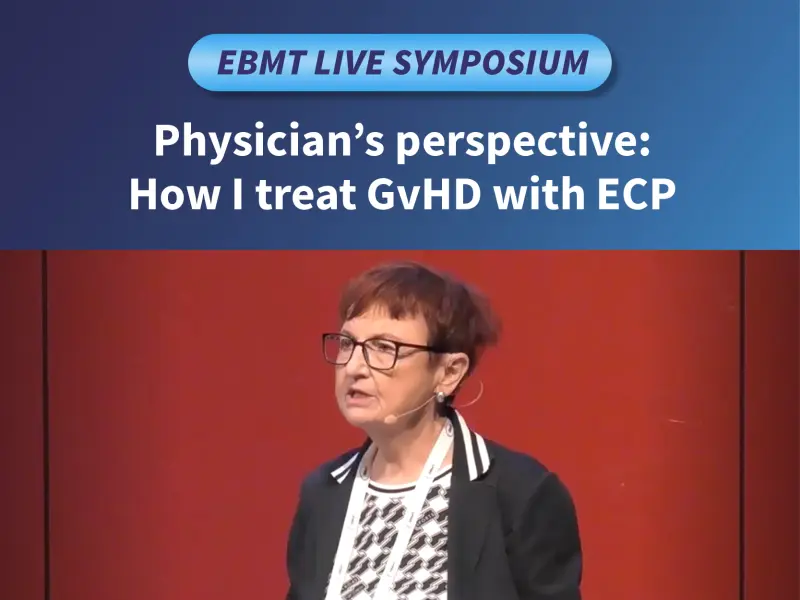
The GvHD Hub was pleased to speak with Hildegard Greinix, Medical University of Vienna, Vienna, AT. We asked, What are the ongoing unmet needs in SR-GvHD, and how can ECP potentially address these?
What are the ongoing unmet needs in SR-GvHD, and how can ECP potentially address these?
In this interview, Greinix discusses key unmet needs in the treatment of patients with steroid-refractory graft-versus-host disease (SR-GvHD), including variable and transient responses to available second-line therapies, treatment-related side effects, and the potential risk of infections or relapse. She explores the potential the role of extracorporeal photopheresis (ECP) in addressing these needs, highlighting its association with durable responses, favorable safety profile without generalized immunosuppression, and no reported interactions with other drugs.
Key points
- Corticosteroids remain the standard first-line treatment for GvHD; however, only up to 50–60% of patients respond, with many requiring subsequent salvage or second-line therapy.1
- Despite the availability of several treatment options for SR-GvHD, existing second-line agents may not adequately control GvHD activity and may be associated with several side effects, particularly profound systemic immunosuppression, an increased risk of infection, disease relapse, or unacceptable late effects.1
- ECP is an immunomodulatory, leukapheresis-based procedure that has an established role in the management of SR-GvHD.1,2
- ECP promotes immune tolerance rather than causing generalized immunosuppression and has a favorable safety profile, with no reported drug interactions.2,3
- Sustained responses to ECP have been reported in patients with SR-GvHD.4
- Responses to systemic therapies for GvHD may vary by organ involvement.5,6
- For example, in patients with chronic GvHD (cGvHD) in the ruxolitinib group of the REACH3 trial (NCT03112603), the Week 24 response rate was 8.6% in the lung, compared with 49.7% overall.5
- ECP may help stabilize or improve pulmonary function in patients with pulmonary cGvHD, including bronchiolitis obliterans syndrome, although additional randomized controlled trials are needed to further define its clinical benefit in this setting.7
- Combination strategies involving ECP are increasingly being explored, with studies evaluating its use in combination with agents such as ruxolitinib and belumosudil.8,9
- In a retrospective study, ruxolitinib in combination with ECP in patients with SR-acute GvHD (aGvHD) was associated with improved long-term control of aGvHD and a lower incidence of cGvHD at 1 year compared with ruxolitinib alone.9
- In summary, ECP may help address key unmet needs in SR-GvHD by providing durable disease control without generalized immunosuppression, while demonstrating a favorable safety profile and potential for use in different combination approaches.1–4,8,9
This educational resource is independently supported by Therakos. All content is developed by SES in collaboration with an expert steering committee. Funders are allowed no influence.
References
- Drexler B, Buser A, Infanti L, et al. Extracorporeal photopheresis in graft-versus-host disease. Transfus Med Hemother. 2020;47(3):214-225. DOI: 10.1159/000508169
- Bojanic I, Worel N, Pacini CP, et al. Extracorporeal photopheresis as an immunomodulatory treatment modality for chronic GvHD and the importance of emerging biomarkers. Front Immunol. 2023;14:1086006. DOI: 10.3389/fimmu.2023.1086006
- Das-Gupta E, Dignan F, Shaw B, et al. Extracorporeal photopheresis for treatment of adults and children with acute GVHD: UK consensus statement and review of published literature. Bone Marrow Transplant. 2014;49(10):1251-1258. DOI: 10.1038/bmt.2014.106
- Couriel DR, Hosing C, Saliba R, et al. Extracorporeal photochemotherapy for the treatment of steroid-resistant chronic GVHD. Blood. 2006;107(8):3074-3080. DOI: 10.1182/blood-2005-09-3907
- Zeiser R, Polverelli N, Ram R, et al. Ruxolitinib for glucocorticoid-refractory chronic graft-versus-host disease. N Engl J Med. 2021;385(3):228-238. Supplementary appendix. DOI: 10.1056/NEJMoa2033122
- Zeiser R, von Bubnoff N, Butler J, et al. Ruxolitinib for glucocorticoid-refractory acute graft-versus-host disease. N Engl J Med. 2020;382(19):1800-1810. DOI: 10.1056/NEJMoa1917635
- Bos S, Murray J, Marchetti M, et al. ERS/EBMT clinical practice guidelines on treatment of pulmonary chronic graft-versus-host disease in adults. Eur Respir J. 2024;63(3):2301727. DOI: 10.1183/13993003.01727-2023
- Salhotra A, Rota L, Marshall K, et al. Belumosudil combination therapy with extracorporeal photopheresis in chronic graft-versus-host disease: Results from the ROCKstar study. Poster #21. 8th International cGvHD Symposium; May 22–23, 2026; Dubrovnik, HR.
- Lastovytska I, Heidenreich S, Klyuchnikov E, et al. Lower incidence of chronic graft-versus-host disease after ruxolitinib plus extracorporeal photopheresis versus ruxolitinib alone in steroid-refractory acute graft-versus-host disease following allogeneic stem cell transplantation. Haematologica. 2025;110(7):1536-1544. DOI: 10.3324/haematol.2024.286824. Erratum in: Haematologica. 2026;111(3):1136-1137. DOI: 10.3324/haematol.2025.289363
Please indicate your level of agreement with the following statements:
The content was clear and easy to understand
The content addressed the learning objectives
The content was relevant to my practice
I will change my clinical practice as a result of this content
This content is accurate as of the date of publication and is not updated retrospectively. Please refer to the latest available evidence, guidelines, and relevant regulatory information when making clinical decisions.