All content on this site is intended for healthcare professionals only. By acknowledging this message and accessing the information on this website you are confirming that you are a healthcare professional. If you are a patient or carer, please visit Know GvHD.
The GvHD Hub website uses a third-party service provided by Google that dynamically translates web content. Translations are machine generated, so may not be an exact or complete translation, and the GvHD Hub cannot guarantee the accuracy of translated content. The GvHD Hub and its employees will not be liable for any direct, indirect, or consequential damages (even if foreseeable) resulting from use of the Google Translate feature. For further support with Google Translate, visit Google Translate Help.


The GVHD Hub is an independent medical education platform, sponsored by Medac and supported through independent educational grants from Incyte, Sanofi and Therakos. Funders are allowed no direct influence on our content. The levels of sponsorship listed are reflective of the amount of funding given. View funders.
Now you can support HCPs in making informed decisions for their patients
Your contribution helps us continuously deliver expertly curated content to HCPs worldwide. You will also have the opportunity to make a content suggestion for consideration and receive updates on the impact contributions are making to our content.
Find out more
Create an account to access:
Bookmark & personalize site content
Receive alerts for new content in your areas of interest
View GvHD content recommended for you
MSCs: From clinical trials to clinical practice
 Mohamad Mohty
 Florent Malard
 Robert Zeiser
 Yi-Bin Chen
 Corey Cutler
 Daniel Wolff
 Andrew Harris
Do you know... Which mechanism is not involved in the immunosuppressive and immunoregulatory effects of mesenchymal stromal cells (MSCs)?
During the GvHD Hub Steering Committee Meeting in December 2025, key opinion leaders met to discuss the use of mesenchymal stromal cells (MSCs) in the treatment of graft-versus-host disease (GvHD), with a focus on steroid-refractory (SR) and treatment-refractory disease. The meeting opened with a presentation by Robert Zeiser and featured a discussion including Mohamad Mohty, Yi-Bin Chen, Daniel Wolff, Florent Malard, Corey Cutler, and Andrew Harris.
During his presentation, Zeiser outlined the proposed mechanism of action of MSCs, describing how they promote an immunosuppressive and immunoregulatory environment (Figure 1). He explored the evolving clinical trial landscape of MSCs in the treatment of GvHD, beginning with the first reported use in 2004, and summarized key trial results leading to the approval of the MSC products remestemcel-L and JR-031. Zeiser highlighted the challenge of MSC product variability, which has contributed to heterogenous response rates across studies, and introduced MSC-Frankfurt am Main (FFM), an MSC product generated by pooling bone marrow-derived mononuclear cells (BM-MNCs) from eight human leukocyte antigen (HLA)-disparate donors to reduce variability. He also explored MSC-FFM outcomes across real-world cohorts and presented the study designs of ongoing phase II/III trials.
MSCs: From clinical trials to clinical practice
MSCs: From clinical trials to clinical practice
Figure 1. Proposed mechanism of action of MSCs*
Key points
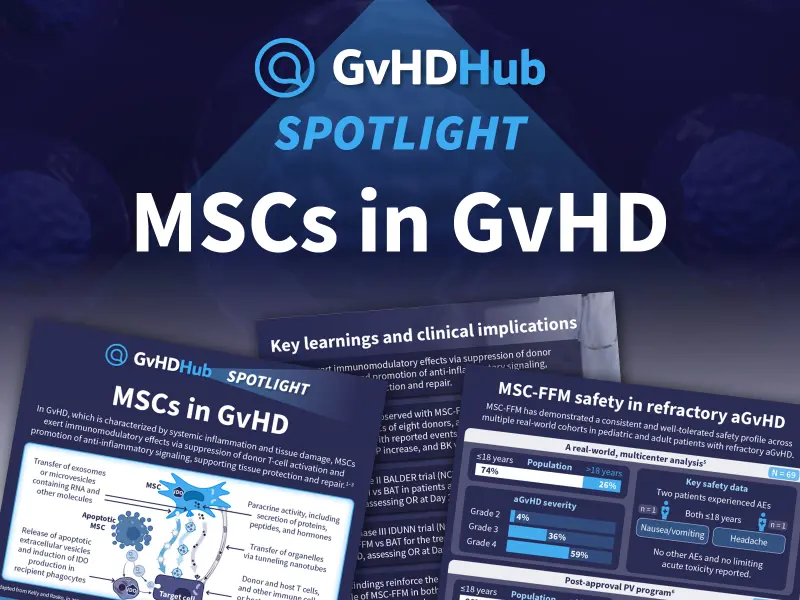
- MSCs promote an immunosuppressive and immunoregulatory environment via multiple mechanisms, including the release of proteins, peptides, and hormones, organelle transfer, and the release of exosomes or microvesicles carrying RNA and other molecules.1
- MSCs are commonly defined by surface marker expression (e.g. PDGFRα, CD73, STRO-1) and by their capacity to differentiate into cartilage and bone under specific culture conditions.2,3
- The first use of MSCs for the treatment of GvHD in a human patient was reported in 2004. A 9-year-old male developed Grade 4 acute GvHD (aGvHD) following allogeneic hematopoietic stem cell transplantation (allo-HSCT) with an HLA-matched unrelated donor.1
- He was refractory to corticosteroids and second-line agents and received two infusions of BM-MSCs from a related donor on Days 73 and 150 post-transplant; following the second infusion, the patient recovered and was alive after 1 year.1
- Remestemcel-L, an MSC product, was approved by the U.S. Food and Drug Administration (FDA) in December 2024 for the treatment of pediatric patients with SR-aGvHD, based on phase III trial results (NCT02336230; N = 54).4,5
- The overall response (OR) at Day 28 was 70.4% vs 45% in the prespecified control (p = 0.0003). Steroids were slowly tapered in patients who responded, leading to a decrease in steroid-related adverse events (AEs).4
- The most common treatment-emergent AE through Day 100 was infections (83.3%).4
- The MSC product JR-031 was approved by the Japanese Pharmaceuticals and Medical Devices Agency in 2015 for the treatment of aGvHD in both pediatric and adults based on phase I/II (N = 14) and II/III (N = 25) trial results.6–8
- In the phase II/III trial, 12 patients with Grade 3 or 4 aGvHD achieved a CR by Week 24.6,8
- Although clinical studies of MSCs for SR-aGvHD have produced encouraging efficacy results, response rates have varied, which may be due to the variable quality of MSCs and lack of a robust manufacturing process.1,9 Therefore, future trials should adopt standardized definitions and characterization criteria.
- MSC-FFM is an MSC product generated by pooling BM-MNCs from eight HLA-disparate donors to reduce variability. It is available in Germany under the advanced therapy medicinal products hospital exemption framework for the treatment of SR or ruxolitinib-refractory aGvHD, allowing controlled national clinical use outside of centralized European Medicines Agency (EMA) approval.6,10
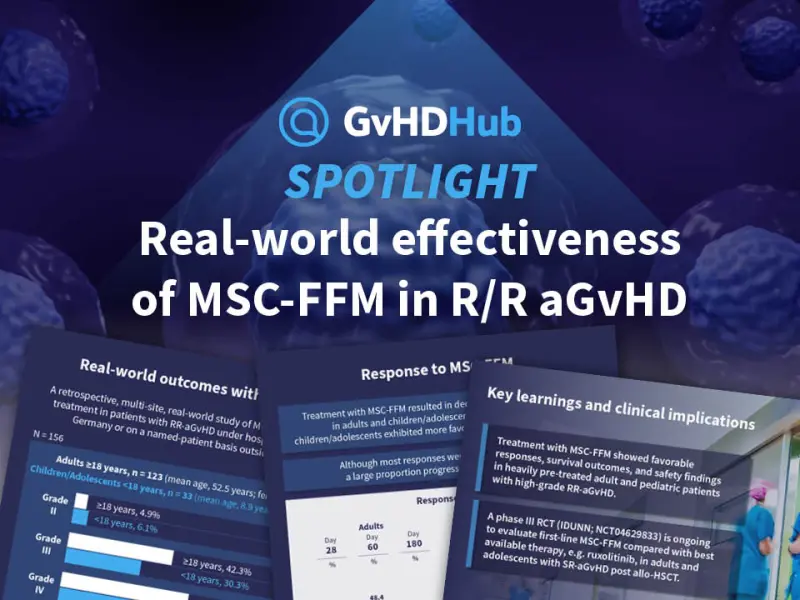
- In a real-world study of MSC-FFM in patients with SR or treatment-refractory aGvHD (N = 69), 22 patients achieved a CR and 35 a PR by Day 28; the only reported AEs were nausea/vomiting and headache (n = 1 each).9
- The ongoing randomized, phase II BALDER trial (NCT06075706) is evaluating MSC-FFM vs best available therapy (BAT) in pediatric patients with SR-aGvHD, with OR at Day 28 as the primary endpoint.11
- The ongoing randomized, phase III IDUNN trial (NCT04629833) is investigating MSC-FFM vs BAT in adolescent and adult patients with SR-aGvHD, with OR at Day 28 and overall survival up to Month 24 as primary endpoints.12
- US-based trials are planned or ongoing, including phase III studies combining MSCs in combination with ruxolitinib as second-line therapy for SR-aGvHD.
- Conducting randomized trials in the third-line setting is increasingly challenging due to small patient populations, prior treatment exposure, and competing risks. There remains heterogeneity in the choice of BAT, with some patients receiving ruxolitinib and others receiving extracorporeal photopheresis.
- The identification of optimal patient subgroups for MSC therapy remains a key research need, including organ involvement and severity stratification.
- Early intervention may improve prognosis, rather than reserving MSCs for late-stage, refractory disease. Ongoing trials will inform optimal sequencing of MSCs in second-line therapy and their role in combination regimens.
This discussion topic is supported by Medac, who provided funding. All content was developed independently by the steering committee in collaboration with SES. Funders were allowed no influence on the content of the discussion.
References
Please indicate your level of agreement with the following statements:
The content was clear and easy to understand
The content addressed the learning objectives
The content was relevant to my practice
I will change my clinical practice as a result of this content
This content is accurate as of the date of publication and is not updated retrospectively. Please refer to the latest available evidence, guidelines, and relevant regulatory information when making clinical decisions.