All content on this site is intended for healthcare professionals only. By acknowledging this message and accessing the information on this website you are confirming that you are a healthcare professional. If you are a patient or carer, please visit Know GvHD.
The GvHD Hub website uses a third-party service provided by Google that dynamically translates web content. Translations are machine generated, so may not be an exact or complete translation, and the GvHD Hub cannot guarantee the accuracy of translated content. The GvHD Hub and its employees will not be liable for any direct, indirect, or consequential damages (even if foreseeable) resulting from use of the Google Translate feature. For further support with Google Translate, visit Google Translate Help.


The GVHD Hub is an independent medical education platform, sponsored by Medac and supported through independent educational grants from Incyte, Sanofi and Therakos. Funders are allowed no direct influence on our content. The levels of sponsorship listed are reflective of the amount of funding given. View funders.
Now you can support HCPs in making informed decisions for their patients
Your contribution helps us continuously deliver expertly curated content to HCPs worldwide. You will also have the opportunity to make a content suggestion for consideration and receive updates on the impact contributions are making to our content.
Find out more
Create an account to access:
Bookmark & personalize site content
Receive alerts for new content in your areas of interest
View GvHD content recommended for you
Immunomodulatory mechanisms of MSCs in acute GvHD
Do you know... Which of the following mechanisms does not contribute to the immunosuppressive and immunoregulatory effects of MSCs?
Acute graft-versus-host disease (aGvHD) is a significant immune-mediated complication of allogeneic hematopoietic stem cell transplantation (allo-HSCT), with only ~60% of patients experiencing a response to first-line treatment with high-dose corticosteroids.1–3 Ruxolitinib is the consensus second-line treatment for steroid-refractory aGvHD (SR-aGvHD); however, responses are not sustained in a substantial proportion of patients, highlighting the need for alternative treatment approaches.1–4
Mesenchymal stromal cells (MSCs) have been evaluated as a potential treatment for SR-aGvHD due to their immunomodulatory properties.5 Remestemcel-L, an MSC product, was approved by the U.S. Food and Drug Administration (FDA) in December 2024 for the treatment of pediatric patients (aged ≥2 months) with SR-aGvHD.6 As MSCs lack human leukocyte antigen class II expression, they can be administered as an allogeneic therapy without donor−recipient matching.7 Although the precise mechanisms underlying the effects of MSCs in aGvHD remain incompletely understood, evidence suggests that their therapeutic activity is mediated by multiple interconnected pathways involving soluble factors, extracellular vesicles (EVs), and modulation of immune-cell function.7,8 In this article, we explore the proposed immunomodulatory mechanisms underlying the therapeutic effects of MSCs in aGvHD.
Proposed mechanisms of MSC-mediated immunomodulation in aGvHD
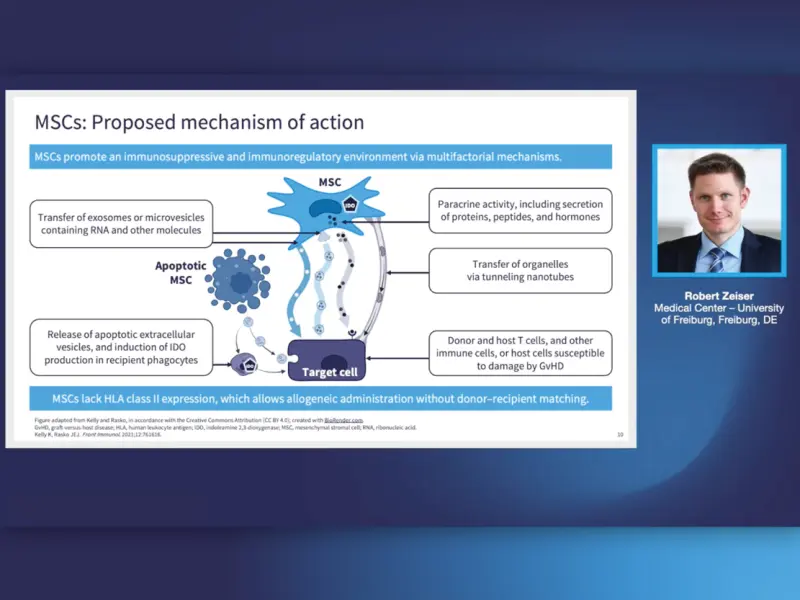
MSCs promote an immunosuppressive and immunoregulatory environment via several potentially overlapping mechanisms (Figure 1).7 Although no single dominant mechanism has been conclusively established in patients with aGvHD, proposed mechanisms include:9
1) EV-mediated transfer of bioactive molecules. MSCs release EVs, including exosomes and microvesicles, that carry RNA and other bioactive molecules capable of influencing target cell function.7 Although the mechanisms underlying EV-mediated immunomodulation remain under investigation, one proposed process involves the shuttling of MSC-derived interleukin-10 (IL-10) messenger RNA to recipient cells that lack this transcript, enabling them to produce this anti-inflammatory cytokine.9–11
2) Paracrine signaling, including the secretion of proteins, peptides, and hormones. MSCs secrete a range of soluble factors that have been proposed to mediate immunosuppressive activity, including transforming growth factor-β1, prostaglandin E2 (PGE2), hepatocyte growth factor (HGF), indoleamine 2,3-dioxygenase (IDO), nitric oxide, and IL-10.7,8 Inflammatory cytokines, such as interferon-γ and tumor necrosis factor-α, can stimulate MSCs to further increase IDO production, which in turn leads to suppression of allogeneic T-cell proliferation.7,8 As exposure to inflammatory signals supports the immunosuppressive function of MSCs, their administration earlier in aGvHD, when pro-inflammatory signals may be more pronounced, could enhance their therapeutic activity.9
3) Organelle transfer. MSCs can transfer mitochondria to target cells through direct cell-to-cell connections known as tunneling nanotubes.7 In experimental studies, mitochondrial transfer from MSCs to T cells has been associated with induction of regulatory T-cell differentiation and reduced inflammatory activity.12 As T cells play a central role in the pathogenesis of aGvHD, this mechanism may help limit T-cell-mediated inflammation and tissue damage.13
4) Apoptosis of MSCs. MSCs undergoing apoptosis in vivo may exert immunomodulatory effects through the production and release of apoptotic EVs and interactions with recipient phagocytes.7 For example, apoptotic MSCs have been reported to induce IDO production in recipient phagocytes, thereby promoting an immunosuppressive environment.14
Figure 1. Proposed mechanisms of action of MSCs in aGvHD*
.png)
Collectively, these mechanisms may influence the activity and function of multiple immune cell populations involved in aGvHD (Figure 2).7,8,15 These effects may include suppression of B- and T-cell proliferation, generation and induction of regulatory T cells, and inhibition of natural killer cell activation and cytotoxicity. MSCs may also impair dendritic cell maturation and activation via secretion of PGE2, thereby reducing antigen presentation and their capacity to activate effector T cells.8,15 Together, these effects may promote a more tolerogenic environment and limit the alloreactive immune responses that drive tissue injury in aGvHD.16
Figure 2. Effects of MSCs on immune-cell populations in aGvHD*
.png)
Current evidence suggests that MSCs exert variable immunomodulatory effects on the same types of immune cells depending on the local microenvironment or disease status.8 For example, MSC treatment is associated with a reduction in the relative proportion of T helper 1 (Th1) cells in patients with aGvHD;17 however, bone marrow-derived MSCs can also promote a shift from Th2 to Th1 responses in airway allergic inflammatory diseases.18–20 These findings suggest that MSCs can switch their effects to protect the body from disease in different situations.8
Tissue-protective and reparative effects of MSCs
In addition to their immunomodulatory effects, MSCs have been shown to limit tissue damage and stimulate tissue repair.7 It was originally hypothesized that, upon administration, MSCs would migrate to sites of injury, engraft, and differentiate into functional cells to replace damaged tissue. However, emerging evidence suggests that MSC-mediated tissue repair may occur primarily through alternative mechanisms, particularly the paracrine secretion of growth factors, cytokines, and other bioactive mediators that influence the function of endogenous recipient cells. These factors, including vascular endothelial growth factor, platelet-derived growth factor, and HGF, can contribute to tissue rescue and repair, although their specific protective and reparative effects in aGvHD are yet to be fully characterized.7,21
Future directions and research gaps
While several studies have reported encouraging outcomes with MSC therapy in aGvHD, others have shown limited or inconsistent efficacy. This variability may reflect differences in MSC source, inter-donor availability, manufacturing processes, and clinical trial design.7,22 Tomostrocel is a standardized, pooled bone marrow-derived MSC product designed to minimize inter-donor variability in MSC products.22 Results from a real-world analysis of tomostrocel for steroid- or treatment-refractory pediatric aGvHD have recently been summarized on the GvHD Hub.22 Further clinical evaluation is needed to determine whether MSC product standardization translates into more consistent treatment outcomes.
Defining the patient subgroups most likely to benefit from MSC therapy remains an important research need. Some studies have reported differences in MSC treatment response according to aGvHD severity and organ involvement, with improved response rates observed in patients with higher-grade disease and those with skin involvement; however, further evaluation is needed to validate these findings.23,24 Moreover, the identification of biomarkers that can differentiate MSC responders from non-responders may also help refine patient selection.24
In practice, MSCs are often co-administered with other immunosuppressive therapies, but the effects of these combinations on MSC therapeutic activity remain unclear.9,25 Ongoing and planned US-based trials, including a phase III trial combining MSCs with ruxolitinib as second-line therapy for SR-aGvHD (NCT07568535), may provide further insights into the role of combination therapy in this setting.26
Conclusion
In summary, MSCs are believed to exert broad immunomodulatory effects in aGvHD through multiple interconnected mechanisms, including paracrine signaling, EV-mediated transfer of RNA and other molecules, mitochondrial transfer, and apoptosis, which may collectively influence immune-cell activity and help limit tissue injury.7,8 Despite these advances in understanding, further research is needed to better characterize the mechanisms underlying MSC activity and establish its optimal clinical use in SR-aGvHD.
This educational resource is independently supported by Medac. All content is developed by SES in collaboration with an expert steering committee. Funders are allowed no influence.
References
- Zeiser R, Ringden O, Sadeghi B, et al. Novel therapies for graft versus host disease with a focus on cell therapies. Front Immunol. 2023;14:1241068. DOI: 10.3389/fimmu.2023.1241068
- Malard F, Holler E, Sandmaier BM, et al. Acute graft-versus-host disease. Nat Rev Dis Primers. 2023;9(1):27. DOI: 10.1038/s41572-023-00438-1
- Daenen LGM, Van Der Wagen LE, Bonneville EF, et al. The use of MSCs in steroid-refractory acute GvHD in Europe: A survey from the EBMT cellular therapy & immunobiology working party. Bone Marrow Transplant. 2025;60(5):708-714. DOI: 10.1038/s41409-025-02531-3
- Zeiser R, Von Bubnoff N, Butler J, et al. Ruxolitinib for glucocorticoid-refractory acute graft-versus-host disease. N Engl J Med. 2020;382(19):1800-1810. DOI: 10.1056/NEJMoa1917635
- Elgaz S, Kuçi Z, Kuçi S, et al. Clinical use of mesenchymal stromal cells in the treatment of acute graft-versus-host disease. Transfus Med Hemother. 2019;46(1):27-34. DOI: 10.1159/000496809
- U.S Food and Drug Administration. FDA approves remestemcel-L-rknd for steroid-refractory acute graft-versus-host disease in pediatric patients. https://www.fda.gov/drugs/resources-information-approved-drugs/fda-approves-remestemcel-l-rknd-steroid-refractory-acute-graft-versus-host-disease-pediatric. Published Dec 18, 2024. Accessed Oct 13, 2026.
- Kelly K, Rasko JEJ. Mesenchymal stromal cells for the treatment of graft versus host disease. Front Immunol. 2021;12:761616. DOI: 10.3389/fimmu.2021.761616
- Gao F, Chiu SM, Motan DAL, et al. Mesenchymal stem cells and immunomodulation: Current status and future prospects. Cell Death Dis. 2016;7(1):e2062-e2062. DOI: 10.1038/cddis.2015.327
- Dunavin N, Dias A, Li M, et al. Mesenchymal stromal cells: What is the mechanism in acute graft-versus-host disease? Biomedicines. 2017;5(3):39. DOI: 10.3390/biomedicines5030039
- Saraiva M, Vieira P, O’Garra A. Biology and therapeutic potential of interleukin-10. J Exp Med. 2020;217(1):e20190418. DOI: 10.1084/jem.20190418
- Ragni E, Banfi F, Barilani M, et al. Extracellular vesicle-shuttled mRNA in mesenchymal stem cell communication. Stem Cells. 2017;35(4):1093-1105. DOI: 10.1002/stem.2557
- Court AC, Le‐Gatt A, Luz‐Crawford P, et al. Mitochondrial transfer from MSCs to T cells induces Treg differentiation and restricts inflammatory response. EMBO Rep. 2020;21(2):EMBR201948052. DOI: 10.15252/embr.201948052
- Ferrara JLM. Pathogenesis of acute graft-versus-host disease: Cytokines and cellular effectors. J Hematother. 2000;9(3):299-306. DOI: 10.1089/15258160050079407
- Galleu A, Riffo-Vasquez Y, Trento C, et al. Apoptosis in mesenchymal stromal cells induces in vivo recipient-mediated immunomodulation. Sci Transl Med. 2017;9(416):eaam7828. DOI: 10.1126/scitranslmed.aam7828
- Amorin B, Alegretti AP, Valim V, et al. Mesenchymal stem cell therapy and acute graft-versus-host disease: A review. Human Cell. 2014;27(4):137-150. DOI: 10.1007/s13577-014-0095-x
- Cheung TS, Bertolino GM, Giacomini C, et al. Mesenchymal stromal cells for graft versus host disease: Mechanism-based biomarkers. Front Immunol. 2020;11:1338. DOI: 10.3389/fimmu.2020.01338
- Keto J, Kaartinen T, Salmenniemi U, et al. Immunomonitoring of MSC-treated GvHD patients reveals only moderate potential for response prediction but indicates treatment safety. Mol Ther Methods Clin Dev. 2018;9:109-118. DOI: 10.1016/j.omtm.2018.02.001
- Cho KS, Park HK, Park HY, et al. IFATS collection: Immunomodulatory effects of adipose tissue-derived stem cells in an allergic rhinitis mouse model. Stem Cells. 2009;27(1):259-265. DOI: 10.1634/stemcells.2008-0283
- Goodwin M, Sueblinvong V, Eisenhauer P, et al. Bone marrow‐derived mesenchymal stromal cells inhibit Th2‐mediated allergic airways inflammation in mice. Stem Cells. 2011;29(7):1137-1148. DOI: 10.1002/stem.656
- Nemeth K, Keane-Myers A, Brown JM, et al. Bone marrow stromal cells use TGF-β to suppress allergic responses in a mouse model of ragweed-induced asthma. Proc Natl Acad Sci USA. 2010;107(12):5652-5657. DOI: 10.1073/pnas.0910720107
- Spees JL, Lee RH, Gregory CA. Mechanisms of mesenchymal stem/stromal cell function. Stem Cell Res Ther. 2016;7(1):125. DOI: 10.1186/s13287-016-0363-7
- Vogelsang K, Zirngibl F, Mezger M, et al. Real-world outcomes of the mesenchymal stromal cell product tomostrocel in heavily pretreated pediatric patients with refractory acute graft-versus-host disease. Haematologica. 2026. Online ahead of print. DOI: 10.3324/haematol.2026.300837
- Debes M, Athwal H, Elyasaky A, et al. Mesenchymal stromal cells in management of steroid refractory acute graft vesrus host disease, systematic review and meta-analysis. Sci Rep. 2025;15(1):44196. DOI: 10.1038/s41598-025-27948-0
- Kadri N, Amu S, Iacobaeus E, et al. Current perspectives on mesenchymal stromal cell therapy for graft versus host disease. Cell Mol Immunol. 2023;20(6):613-625. DOI: 10.1038/s41423-023-01022-z
- Etra A, Ferrara JLM, Levine JE. Remestemcel-L-rknd (Ryoncil): the first approved cellular therapy for steroid-refractory acute GVHD. Blood. 2025;146(16):1897-1901. DOI: 10.1182/blood.2025028553
- ClinicalTrials.gov. A randomized, double-blind, placebo-controlled, multicenter phase III trial of remestemcel-L-Rknd added to ruxolitinib for grade III-IV steroid-refractory acute graft-versus-host disease. https://clinicaltrials.gov/study/NCT07568535. Accessed Oct 16, 2026.
Please indicate your level of agreement with the following statements:
The content was clear and easy to understand
The content addressed the learning objectives
The content was relevant to my practice
I will change my clinical practice as a result of this content
This content is accurate as of the date of publication and is not updated retrospectively. Please refer to the latest available evidence, guidelines, and relevant regulatory information when making clinical decisions.