All content on this site is intended for healthcare professionals only. By acknowledging this message and accessing the information on this website you are confirming that you are a healthcare professional. If you are a patient or carer, please visit Know GvHD.
The GvHD Hub website uses a third-party service provided by Google that dynamically translates web content. Translations are machine generated, so may not be an exact or complete translation, and the GvHD Hub cannot guarantee the accuracy of translated content. The GvHD Hub and its employees will not be liable for any direct, indirect, or consequential damages (even if foreseeable) resulting from use of the Google Translate feature. For further support with Google Translate, visit Google Translate Help.


The GVHD Hub is an independent medical education platform, sponsored by Medac and supported through independent educational grants from Incyte, Sanofi and Therakos. Funders are allowed no direct influence on our content. The levels of sponsorship listed are reflective of the amount of funding given. View funders.
Now you can support HCPs in making informed decisions for their patients
Your contribution helps us continuously deliver expertly curated content to HCPs worldwide. You will also have the opportunity to make a content suggestion for consideration and receive updates on the impact contributions are making to our content.
Find out more
Create an account to access:
Bookmark & personalize site content
Receive alerts for new content in your areas of interest
View GvHD content recommended for you
Defining meaningful treatment benefit in SR-aGvHD
Do you know... What were the findings of the final REACH2 analysis regarding Day 28 ORR and NRM in patients with SR-aGvHD?
Acute graft-versus-host disease (aGvHD) is a significant complication that can occur after allogeneic hematopoietic stem cell transplantation (allo-HSCT).1,2 Standard first-line treatment involves systemic corticosteroids; however, 30–50% of patients do not respond adequately and develop steroid-refractory aGvHD (SR-aGvHD), which is associated with poor outcomes.1,2 Ruxolitinib, a Janus kinase 1/2 inhibitor, is an established second-line treatment for SR-aGvHD, although resistance or intolerance necessitate the investigation of additional treatment options.1–3 Novel targeted agents and combination therapies are under evaluation, alongside non-pharmacologic approaches, including microbiota therapy and mesenchymal stromal cells.1
Defining meaningful treatment benefit is important to inform the evaluation of treatment effectiveness and support clinical decision-making. This requires consideration of outcomes that matter most to patients, including improved survival and quality of life.1,4,5 In this article, we explore what constitutes meaningful treatment benefit in SR-aGvHD, how this may differ between adult and pediatric patients, and the factors that can complicate its definition and assessment.
What does meaningful treatment benefit mean in SR-aGvHD?
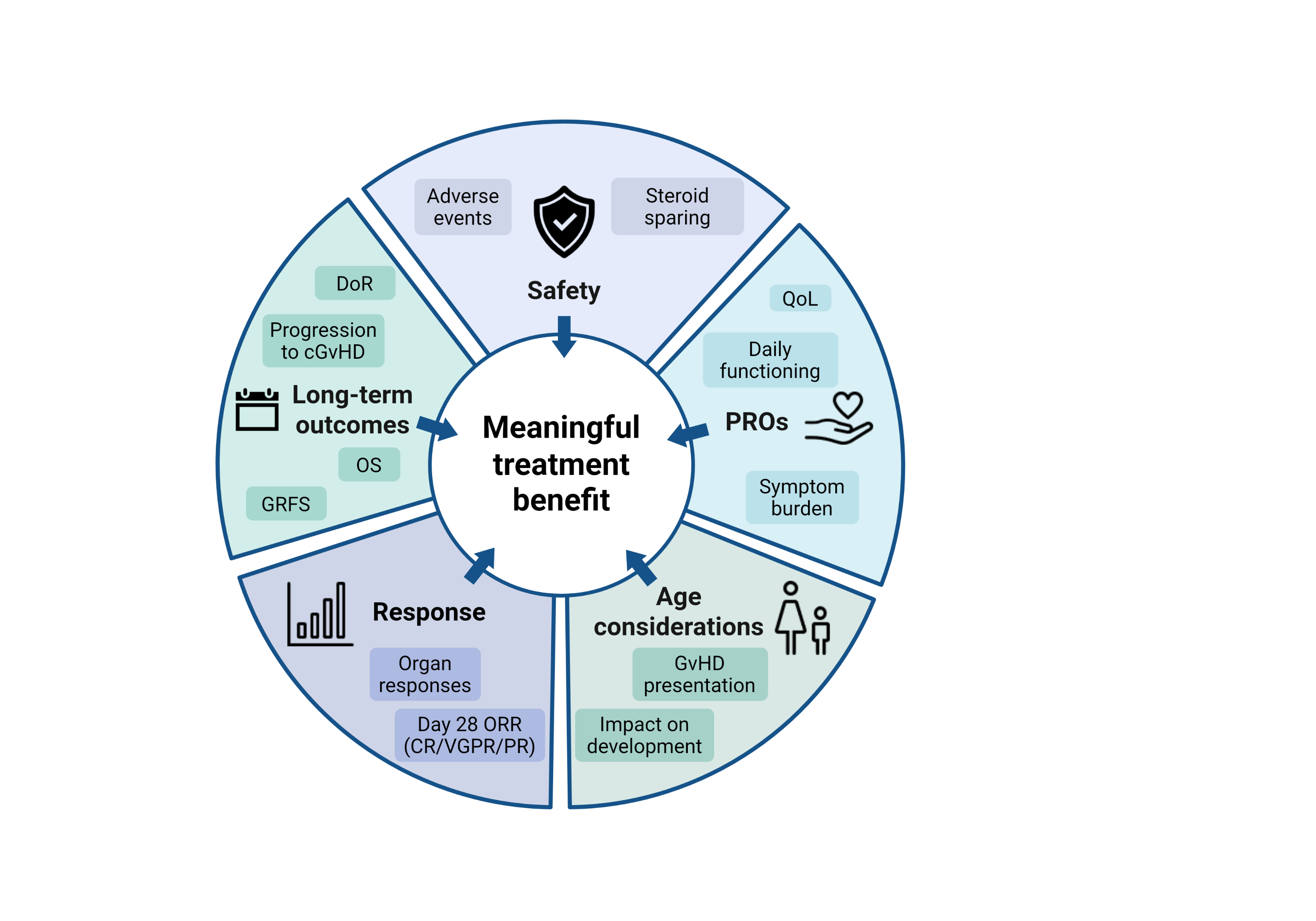
While achieving an initial response is an important treatment goal in SR-aGvHD, meaningful treatment benefit extends beyond this to encompass durable disease control and prevention of further progression (Figure 1).1,6 As short-term responses may not reflect longer-term outcomes in patients with aGvHD, assessing whether responses are sustained over time is a key consideration when evaluating treatment benefit.7 Beyond control of aGvHD, the potential to reduce the risk of developing chronic GvHD (cGvHD) is also important when evaluating longer-term treatment outcomes, particularly as SR-aGvHD has been identified as an independent risk factor for cGvHD following allo-HSCT.8 The extent to which treatment controls disease in individual organs is another important consideration, particularly in the skin, gastrointestinal tract, and liver, which are commonly affected in aGvHD.2
Patient-reported outcomes (PROs), including quality of life, symptom burden, and daily functioning, can also contribute to the overall assessment of treatment benefit.4 These measures capture the impact of SR-aGvHD and its treatment on patients’ everyday lives, complementing clinical assessments of response and longer-term disease control.9
Meaningful treatment benefit also encompasses the safety and tolerability of treatment, including limiting adverse events such as cytopenias and infections, which can occur with existing second-line therapies for SR-aGvHD.10 The steroid-sparing potential of treatment is another important consideration, as reducing corticosteroid exposure may help minimize steroid-related toxicity and complications associated with prolonged use.11–13
Figure 1. Key considerations when evaluating treatment benefit in SR-aGvHD*
How does meaningful benefit differ between pediatric and adult patients?
Differences between pediatric and adult populations should be taken into account when evaluating treatment benefit in SR-aGvHD. aGvHD presentation, severity, and treatment response can vary between children and adults, meaning that treatment benefit may need to be assessed using age-specific endpoints and response criteria.14,15 Although disease control, survival, and symptom improvement are relevant across both populations, treatment outcomes in children should also be considered in the context of growth, development, and potential long-term toxicities.16
Why is defining meaningful benefit in SR-aGvHD challenging?
Defining meaningful treatment benefit in SR-aGvHD can be challenging because outcomes measured early after treatment initiation may not reflect the full extent of therapeutic benefit in all patients. For example, in a retrospective, multicenter study evaluating the clinical course and outcomes of pediatric patients (aged 0–18 years) with SR-aGvHD, most patients experienced remission more than 28 days after initiating a line of therapy, suggesting that assessment at Day 28 may not capture all treatment responses in this population.18
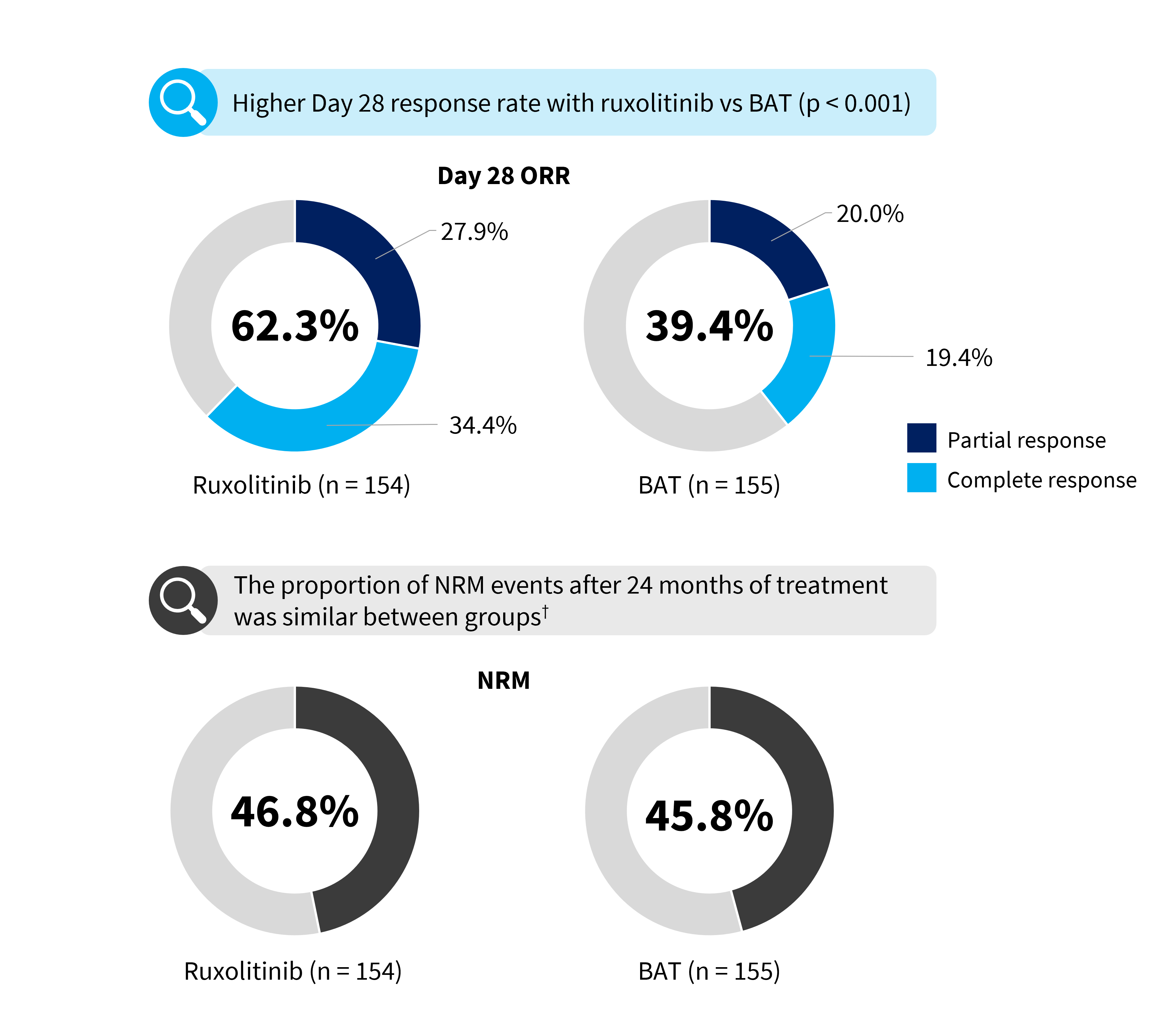
Although Day 28 response in patients with newly diagnosed aGvHD has been associated with 6-month non-relapse mortality (NRM), its ability to predict longer-term outcomes may differ in patients with more advanced disease.19 For example, among patients with Grade 2–4 SR-aGvHD in the phase III REACH2 trial (NCT02913261), ruxolitinib was associated with a higher Day 28 overall response rate compared with best available therapy. However, the number of NRM events was similar between treatment groups (Figure 2).11,20 These findings highlight that improvements in early response do not necessarily translate into improvements across all longer-term clinical outcomes, underscoring the importance of considering multiple measures when evaluating treatment benefit.
Rather than relying on a single assessment at Day 28, evaluating treatment benefit at subsequent time points may help capture delayed responses and determine whether initial improvements are sustained.6 Draft guidance from the U.S. Food and Drug Administration (FDA) on GvHD drug development recommends at least 180 days of follow-up to establish durability of responses in aGvHD.21 Beyond response durability, other clinical endpoints, including GvHD-free survival, relapse, and overall survival, can provide complementary information to support the evaluation of treatment benefit.19 Although PROs are important for understanding treatment benefit, they are not routinely incorporated as clinical trial endpoints, underscoring the need to better capture the broader impact of SR-aGvHD and its treatment on patients' lives.22
Figure 2. REACH2 efficacy outcomes: Ruxolitinib vs BAT in patients with SR-aGvHD*
Research gaps and future directions
Identifying biomarkers and clinical characteristics that predict treatment response may help guide personalized treatment selection and identify patients with SR-aGvHD most likely to derive benefit from specific therapies.1,19 Moreover, greater standardization of endpoints in SR-aGvHD clinical trials is needed to support more consistent evaluation of treatment benefit and facilitate comparisons across studies.23 Greater alignment with regulatory agency expectations may also help ensure that endpoints are appropriate for demonstrating clinical benefit, and supporting the development and approval of new treatments for patients with SR-aGvHD.19
These considerations are particularly relevant in pediatric patients with SR-aGvHD, for whom effective treatment options remain a significant unmet need. To date, few therapies have been evaluated in robust clinical trials in this population. The limited number and small size of studies present challenges for establishing treatment efficacy and supporting regulatory approval of new therapies in pediatric SR-aGvHD.24
Conclusion
Defining meaningful treatment benefit in SR-aGvHD requires consideration of outcomes beyond early response, including durability of response, long-term survival, limited treatment-related toxicity, and improvements in PROs. Differences in disease presentation and treatment priorities between pediatric and adult patients should be considered when determining which outcomes best reflect meaningful treatment benefit, ensuring that these outcomes are relevant to the clinical needs of each population.
This educational resource is independently supported by Medac. All content is developed by SES in collaboration with an expert steering committee. Funders are allowed no influence
References
- Ye Y, Hao W, Malard F, et al. Emerging novel therapies for steroid-refractory acute graft-versus-host disease: Recent advances and future directions. Curr Opin Immunol. 2025;96:102649. DOI: 10.1016/j.coi.2025.102649
- Malard F, Holler E, Sandmaier BM, et al. Acute graft-versus-host disease. Nat Rev Dis Primers. 2023;9(1):27. DOI: 10.1038/s41572-023-00438-1
- Zuluaga J, Kanelopoulos A, Nikolousis E. Second-line and salvage therapies for steroid-refractory acute graft-versus-host disease: An integrated synthesis of current evidence and clinical sequencing. Curr Opin Hematol. 2026;33(6):265-270. DOI: 10.1097/MOH.0000000000000952
- Leeneman B, Blommestein HM, Van Dongen‐Leunis A, et al. Health‐related quality of life in patients with steroid‐refractory acute graft‐versus‐host disease. European J of Haematology. 2023;111(2):240-246. DOI: 10.1111/ejh.13987
- Canada Journal of Health Technologies. CADTH Reimbursement Recommendation: Ruxolitinib (Jakavi). https://www.cda-amc.ca/sites/default/files/DRR/2022/SR0706REC-Jakavi-(Chronic).pdf. Accessed Oct 23, 2026.
- Martin PJ, Bachier CR, Klingemann HG, et al. Endpoints for clinical trials testing treatment of acute graft-versus-host disease: A joint statement. Biol Blood Marrow Transplant. 2009;15(7):777-784. DOI: 10.1016/j.bbmt.2009.03.012
- Inamoto Y, Martin PJ, Storer BE, et al. Response endpoints and failure-free survival after initial treatment for acute graft-versus-host disease. Haematologica. 2014;99(2):385-391. DOI: 10.3324/haematol.2013.093062
- Herzog S, Weisdorf DJ, Shanley R, et al. Chronic GvHD after steroid-sensitive, -dependent, and -refractory acute GvHD: Incidence and clinical outcomes. Blood Adv. 2023;7(14):3644-3650. DOI: 10.1182/bloodadvances.2022009505
- Lee SJ, Williams LA. Patient-reported outcomes for acute graft-versus-host disease prevention and treatment trials. Biol Blood Marrow Transplant. 2010;16(3):295-300. DOI: 10.1016/j.bbmt.2009.08.021
- Luo C, Huang X, Wei L, et al. Second-line therapy for patients with steroid-refractory aGvHD: Systematic review and meta-analysis of randomized controlled trials. Front Immunol. 2023;14:1211171. DOI: 10.3389/fimmu.2023.1211171
- Zeiser R, Von Bubnoff N, Butler J, et al. Ruxolitinib for glucocorticoid-refractory acute graft-versus-host disease. N Engl J Med. 2020;382(19):1800-1810. DOI: 10.1056/NEJMoa1917635
- Kujawska J, Zeiser R, Gil L. Recent advances in acute gastrointestinal graft versus host disease (aGvHD): Aspects of steroid-resistant disease. Ann Hematol. 2025;104(2):855-865. DOI: 10.1007/s00277-024-05952-0
- Martin PJ, Rizzo JD, Wingard JR, et al. First- and second-line systemic treatment of acute graft-versus-host disease: Recommendations of the American Society of Blood and Marrow Transplantation. Biol Blood Marrow Transplant. 2012;18(8):1150-1163. DOI: 10.1016/j.bbmt.2012.04.005
- Lawitschka A, Lucchini G, Strahm B, et al. Pediatric acute graft‐versus‐host disease prophylaxis and treatment: Surveyed real‐life approach reveals dissimilarities compared to published recommendations. Transpl Int. 2020;33(7):762-772. DOI: 10.1111/tri.13601
- Schoemans HM, Lee SJ, Ferrara JL, et al. EBMT−NIH−CIBMTR Task Force position statement on standardized terminology & guidance for graft-versus-host disease assessment. Bone Marrow Transplant. 2018;53(11):1401-1415. DOI: 10.1038/s41409-018-0204-7
- Gatza E, Reddy P, Choi SW. Prevention and treatment of acute graft-versus-host disease in children, adolescents, and young adults. Biol Blood Marrow Transplant. 2020;26(5):e101-e112. DOI: 10.1016/j.bbmt.2020.01.004
- Magenau J, Braun T, Gatza E, et al. Assessment of individual versus composite endpoints of acute graft-versus-host disease in determining long-term survival after allogeneic transplantation. Biol Blood Marrow Transplant. 2019;25(8):1682-1688. DOI: 10.1016/j.bbmt.2019.01.024
- Verbeek AB, Jansen SA, Von Asmuth EGJ, et al. Clinical features, treatment, and outcome of pediatric steroid refractory acute graft-versus-host disease: A multicenter study. Transplant Cell Ther. 2022;28(9):600.e1-600.e9. DOI: 10.1016/j.jtct.2022.06.008
- Smallbone P, Mehta RS, Alousi A. Steroid refractory acute GVHD: The hope for a better tomorrow. American J Hematol. 2025;100(S3):14-29. DOI: 10.1002/ajh.27592
- Mohty M, Socié G, Szer J, et al. Ruxolitinib versus best available therapy in patients with steroid-refractory acute graft-versus-host disease: Final analysis from the randomized phase III REACH2 trial. J Clin Oncol. 2025;43(34):3639-3645. DOI: 10.1200/JCO-25-00809
- U.S. Food and Drug Administration. Graft-versus-host diseases: Developing drugs, biological products, and certain devices for prevention or treatment. https://www.fda.gov/regulatory-information/search-fda-guidance-documents/graft-versus-host-diseases-developing-drugs-biological-products-and-certain-devices-prevention-or. Published Sep 28, 2023. Accessed Oct 23, 2026
- Shaw BE. Graft versus host disease clinical trials: Is it time for patients centered outcomes to be the primary objective? Curr Hematol Malig Rep. 2019;14(1):22-30. DOI: 10.1007/s11899-019-0494-x
- Malard F, Huang XJ, Sim JPY. Treatment and unmet needs in steroid-refractory acute graft-versus-host disease. Leukemia. 2020;34(5):1229-1240. DOI: 10.1038/s41375-020-0804-2
- Satwani P, Chaudhury S, Musat MG, et al. Efficacy of treatment options for children with steroid-refractory acute GvHD. Blood. 2023;142(Suppl. 1):7013-7013. DOI: 10.1182/blood-2023-187609
Please indicate your level of agreement with the following statements:
The content was clear and easy to understand
The content addressed the learning objectives
The content was relevant to my practice
I will change my clinical practice as a result of this content
This content is accurate as of the date of publication and is not updated retrospectively. Please refer to the latest available evidence, guidelines, and relevant regulatory information when making clinical decisions.