All content on this site is intended for healthcare professionals only. By acknowledging this message and accessing the information on this website you are confirming that you are a healthcare professional. If you are a patient or carer, please visit Know GvHD.
The GvHD Hub website uses a third-party service provided by Google that dynamically translates web content. Translations are machine generated, so may not be an exact or complete translation, and the GvHD Hub cannot guarantee the accuracy of translated content. The GvHD Hub and its employees will not be liable for any direct, indirect, or consequential damages (even if foreseeable) resulting from use of the Google Translate feature. For further support with Google Translate, visit Google Translate Help.


The GVHD Hub is an independent medical education platform, sponsored by Medac and supported through independent educational grants from Incyte, Sanofi and Therakos. Funders are allowed no direct influence on our content. The levels of sponsorship listed are reflective of the amount of funding given. View funders.
Now you can support HCPs in making informed decisions for their patients
Your contribution helps us continuously deliver expertly curated content to HCPs worldwide. You will also have the opportunity to make a content suggestion for consideration and receive updates on the impact contributions are making to our content.
Find out more
Create an account to access:
Bookmark & personalize site content
Receive alerts for new content in your areas of interest
View GvHD content recommended for you
How I treat GvHD in children using ECP: Insights from a case study
 Mohamad Mohty
 Hildegard Greinix
 Corey Cutler
 Daniel Wolff
 Andrew Harris
Do you know... Which of the following is not a benefit associated with the use of ECP in pediatric GvHD?
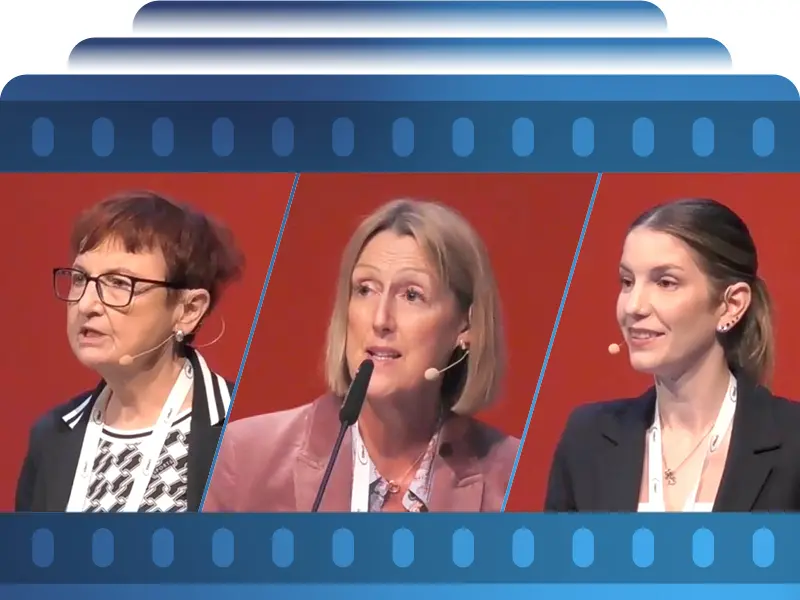
During the GvHD Hub Steering Committee Meeting in July 2026, key opinion leaders met to discuss the use of extracorporeal photopheresis (ECP) for the treatment of pediatric graft-versus-host disease (GvHD). The meeting opened with a presentation from Andrew Harris, and featured a panel discussion with Mohamad Mohty, Corey Cutler, Hildegard Greinix, and Daniel Wolff.
How I treat GvHD in children using ECP: Insights from a case study
How I treat GvHD in children using ECP: Insights from a case study
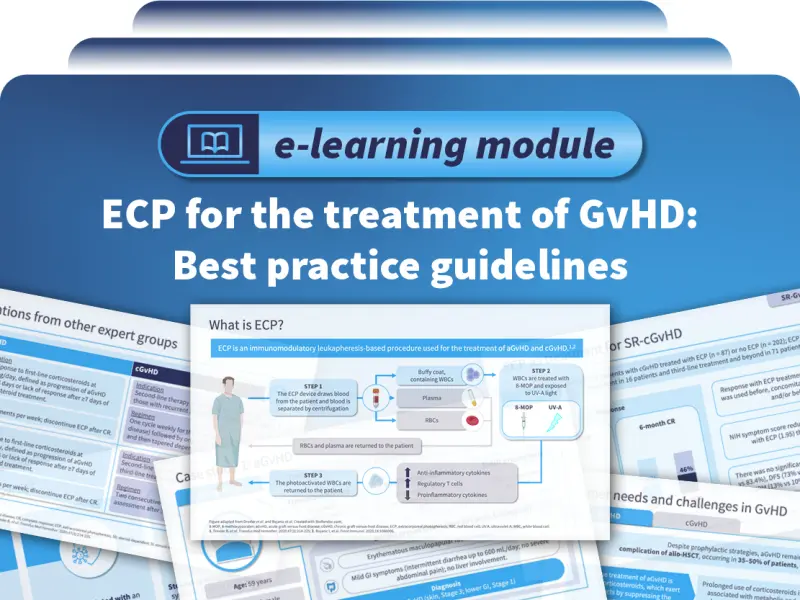
During his presentation, Harris explained that, beyond first-line steroid therapy, the management of GvHD relies on a range of second-line treatment options, noting there are limited data and guidance specific to pediatric patients. Among these, ECP – an immunomodulatory leukapheresis-based therapy – is increasingly being incorporated into clinical practice as a second-line or later treatment. However, its use in pediatric patients remains variable, with no standardized approach. Harris presented a case from his practice involving a 3-year-old patient who developed acute GvHD following transplantation and was treated with ECP (Figure 1 and Figure 2). He also discussed the practical and logistical considerations associated with ECP and explored how micro-ECP may overcome some of the challenges limiting ECP use in pediatric patients.
Figure 1. Clinical case of a 3-year-old male with acute GvHD: Treatment*
.png)
Figure 2. Clinical case of a 3-year-old male with acute GvHD: Follow-up*
.png)
Key points
- Beyond first-line corticosteroids, GvHD care depends on a range of second‑line options, with limited data and guidance specific to pediatric populations.1–3
- There is a significant need for GvHD therapies that reduce reliance on steroids and broad immunosuppression in children.1
- ECP, a leukapheresis-based procedure, is an established treatment option for acute and chronic GvHD.2,4
- ECP has an immunomodulatory mechanism of action, rather than immunosuppressive, and is associated with steroid-sparing efficacy, minimal side effects, no infectious risk outside of central venous line, and no increased risk of relapse.5–9
- Although ECP is increasingly incorporated in clinical practice and recognized in guidelines as a second-line or later treatment option, its use in pediatric patients remains heterogeneous, and the optimal treatment schedule is yet to be determined.2,4
- Harris presents a clinical case of a 3-year-old male who developed acute GvHD following bone marrow transplantation and was treated with ECP as second-line therapy following first-line corticosteroids.
- The patient responded well to ECP, enabling successful corticosteroid tapering, and achieved a complete response by Day 80. After 8 weeks of twice-weekly ECP (Day 108), ECP treatment frequency was reduced without any recurrence of acute GvHD.
- The use of ECP in pediatric patients requires consideration of several practical and logistical factors, including the requirement for an apheresis-capable catheter, the use of blood priming in patients with a low body weight (<25 kg), the time commitment associated with treatment, and the need for administration in experienced centers with appropriate expertise.4,8,10,11
- Although the method remains experimental, micro-ECP has demonstrated efficacy in the treatment of acute and chronic pediatric GvHD,
- In a retrospective study (N = 23), micro-ECP was associated with overall response rates of 44% and 73% in pediatric patients with acute and chronic GvHD, respectively.12
- Combination strategies involving ECP are increasingly being explored, with studies evaluating its use in combination with agents such as ruxolitinib and belumosudil.13,14
This educational activity is independently supported by Therakos. All content is developed by the steering committee in collaboration with SES. Funders are allowed no influence.
References
Please indicate your level of agreement with the following statements:
The content was clear and easy to understand
The content addressed the learning objectives
The content was relevant to my practice
I will change my clinical practice as a result of this content
This content is accurate as of the date of publication and is not updated retrospectively. Please refer to the latest available evidence, guidelines, and relevant regulatory information when making clinical decisions.