All content on this site is intended for healthcare professionals only. By acknowledging this message and accessing the information on this website you are confirming that you are a healthcare professional. If you are a patient or carer, please visit Know GvHD.
The GvHD Hub website uses a third-party service provided by Google that dynamically translates web content. Translations are machine generated, so may not be an exact or complete translation, and the GvHD Hub cannot guarantee the accuracy of translated content. The GvHD Hub and its employees will not be liable for any direct, indirect, or consequential damages (even if foreseeable) resulting from use of the Google Translate feature. For further support with Google Translate, visit Google Translate Help.


The GVHD Hub is an independent medical education platform, sponsored by Medac and supported through independent educational grants from Incyte, Sanofi and Therakos. Funders are allowed no direct influence on our content. The levels of sponsorship listed are reflective of the amount of funding given. View funders.
Now you can support HCPs in making informed decisions for their patients
Your contribution helps us continuously deliver expertly curated content to HCPs worldwide. You will also have the opportunity to make a content suggestion for consideration and receive updates on the impact contributions are making to our content.
Find out more
Create an account to access:
Bookmark & personalize site content
Receive alerts for new content in your areas of interest
View GvHD content recommended for you
Tomostrocel (MSC-FFM) in multi-refractory aGvHD: A real-world analysis
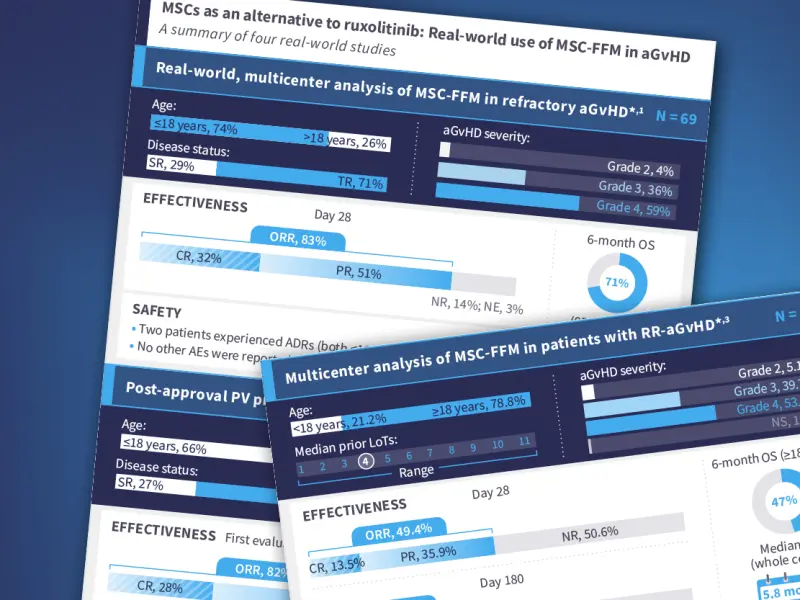
Results from a retrospective analysis of prospectively collected surveillance data evaluating tomostrocel, a mesenchymal stromal cell (MSC) product, in adults with multi-refractory acute graft-versus-host disease (aGvHD; N = 317) treated at European transplant centers between 2017 and 2025 were published in Transplantation and Cellular Therapy by Verbeek et al. aGvHD was mostly severe (Grade 3, 37%; Grade 4, 55%) and the lower gastrointestinal (GI) tract was the predominant site of involvement. Patients had received a median of three prior lines of therapy (LoT), including ruxolitinib in 75% of cases, and were followed for 24 months from first administration of tomostrocel. Response rates, overall survival (OS), and adverse reactions were evaluated.
Key data: At Day 28, the overall response rate (ORR) was 45% (95% confidence interval [CI], 40–51), including a complete response (CR) in 12% of patients. Median OS was 4.3 months, and OS at 6, 12, and 24 months was 44%, 33%, and 28%, respectively. Response and survival were comparable regardless of prior ruxolitinib exposure; Day 28 ORR was 47% in patients who had received ruxolitinib (n = 239) vs 39% in those who had not (n = 78), and 24-month OS was 29% vs 25%, respectively. Adverse drug reactions were reported in 1.6% of patients, including three serious infectious events.
Key learning: In this real-world analysis, tomostrocel demonstrated promising efficacy and a well-tolerated safety profile in heavily pretreated adults with multi-refractory aGvHD. Despite the inherent limitations of real-world data, these findings support further investigation of tomostrocel as a treatment option for this patient population, with further evaluation underway in two randomized controlled trials (NCT04629833, NCT06075706).
References
- Verbeek M, Bonig H, Ayuk F, et al. Treatment of severe acute graft-versus-host disease refractory to multiple lines of therapy: Real-world data from 317 adults treated with the multiple-donor bone marrow-derived mesenchymal stromal cell preparation tomostrocel. Transplant Cell Ther. 2026. Online ahead of print. DOI: 10.1016/j.jtct.2026.09.021
Please indicate your level of agreement with the following statements:
The content was clear and easy to understand
The content addressed the learning objectives
The content was relevant to my practice
I will change my clinical practice as a result of this content
This content is accurate as of the date of publication and is not updated retrospectively. Please refer to the latest available evidence, guidelines, and relevant regulatory information when making clinical decisions.